

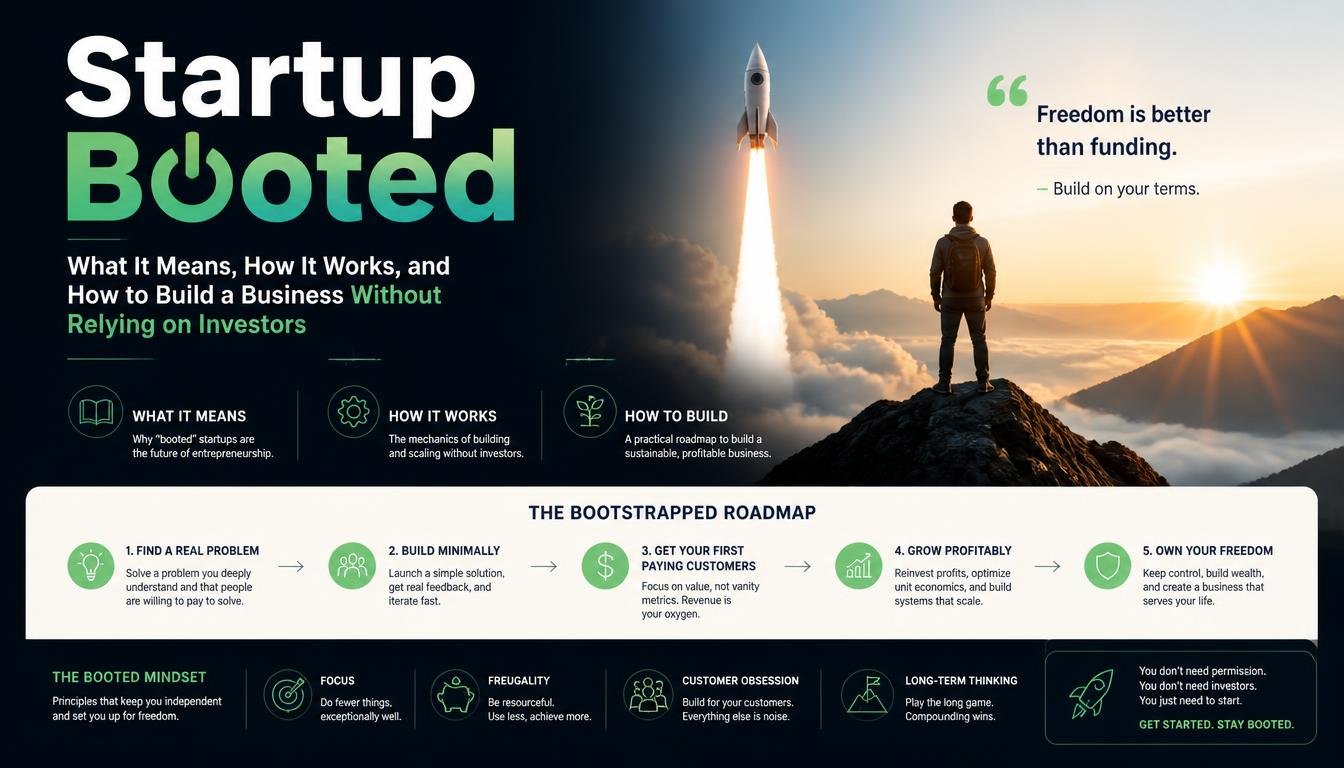
If you’ve searched for “startup booted,” you may have noticed that the phrase isn’t the standard business term. In most startup discussions, the established term is bootstrapped startup, meaning a company funded primarily through the founder’s resources and business revenue rather than traditional venture capital.
The idea is straightforward: build the business with limited outside funding, keep expenses under control, generate customer revenue, and reinvest that money into growth. It can give founders greater control, but it also puts more financial responsibility on them.
This guide explains what startup booted means, how the model works, its advantages and disadvantages, and when bootstrapping makes more sense than raising venture capital.
What Does “Startup Booted” Mean?
Startup booted is generally used as an informal variation of bootstrapped startup. It describes a business that begins and grows primarily through founder funding, customer revenue, retained earnings, or other non-VC resources.
The more established term is “bootstrapping.” The U.S. Small Business Administration describes self-funding, also known as bootstrapping, as using your own financial resources to support a business.
That can include personal savings, early sales, reinvested profits, or financial support from people close to the founder.
The important point is that bootstrapping isn’t simply about having a tiny budget. It’s a business strategy built around making the most of available resources.
A bootstrapped founder may delay hiring, launch a smaller product, negotiate supplier costs, use low-cost marketing, or reinvest early revenue instead of immediately seeking investors.
How Does a Bootstrapped Startup Actually Work?
A bootstrapped startup usually follows a simple financial loop: start lean, acquire customers, generate revenue, and reinvest that revenue into the company.
Unlike a heavily funded startup, the business can’t assume another investment round will arrive whenever cash gets tight.
For example, imagine a founder develops a software product with personal savings. Instead of spending heavily on advertising, the founder first sells the product to a small group of customers.
Those customers generate revenue. The founder then uses part of that revenue to improve the product, acquire more customers, or hire essential help.
Stripe explains that bootstrapping commonly involves personal savings, early revenue, minimizing expenses, and reinvesting profits into the business.
That creates a different mindset from the traditional “raise money first, grow quickly later” approach.
What Are the Main Sources of Bootstrapped Startup Funding?
Bootstrapped companies can use several sources of capital without immediately taking traditional venture capital.
Common sources include:
- Founder savings
- Early customer payments
- Reinvested business revenue
- Preorders
- Friends-and-family funding
- Small-business financing
- Grants or competitions
- Revenue-based financing, where appropriate
Not every option is truly “self-funding.” A loan, for example, creates a repayment obligation, while an equity investment gives another party an ownership stake.
The SBA specifically notes that self-funding can include personal savings and financial support from family and friends, while also warning founders to avoid risking money they cannot afford to lose.
Why Do Founders Choose the Startup Booted Model?
The biggest attraction is control. Founders who don’t sell equity to outside investors generally retain more ownership and decision-making authority.
That can make it easier to choose a long-term strategy instead of optimizing every decision around investor expectations.
YC makes an important point here: the vast majority of businesses don’t raise venture capital, and avoiding VC can be an excellent decision for many companies.
Bootstrapping can also encourage financial discipline.
When money comes directly from the founder or customers, unnecessary spending becomes much harder to justify. That can push the company toward practical decisions rather than impressive-looking expenses.
There’s also a psychological benefit. A founder may feel more comfortable experimenting when there’s no investor board waiting for the next quarterly growth number.
Of course, freedom doesn’t pay the electricity bill. Revenue still matters.
What Are the Biggest Advantages of Startup Booted Growth?
A bootstrapped business can benefit from greater ownership, financial discipline, customer focus, and strategic flexibility.
However, those benefits only appear when the founder manages cash responsibly.
1. More Founder Control
When founders don’t exchange equity for venture capital, they generally maintain greater control over the company’s direction.
The SBA notes that self-funding allows owners to retain complete control while also placing the financial risk on them.
That trade-off is crucial.
You get more control, but you also get more responsibility.
2. Less Equity Dilution
Outside equity funding normally means giving investors a percentage of the company.
Bootstrapping can reduce or delay that dilution because the founder isn’t selling ownership simply to finance early operations.
Stripe notes that avoiding external funding can help founders avoid the equity dilution associated with outside investment.
That doesn’t automatically make bootstrapping better. A smaller percentage of a very valuable company can sometimes be worth more than 100% of a company that never reaches scale.
The smart question is therefore not “How do I keep all my equity?” but “What funding structure gives this business the best chance of creating durable value?”
3. Stronger Focus on Customers
When customers are the primary source of funding, their willingness to pay becomes extremely important.
That creates a useful reality check.
A founder can say that an idea is revolutionary all day. A paying customer provides a much more interesting vote.
Stripe recommends validating demand through real-world feedback, testing pricing, and paying attention to what customers actually do rather than relying only on what they say.
4. Greater Financial Discipline
Bootstrapping forces founders to think carefully about every major expense.
Hiring decisions, software subscriptions, marketing campaigns, inventory purchases, and office costs all compete for limited resources.
Stripe’s bootstrapping guidance emphasizes staying lean, budgeting carefully, allocating resources efficiently, and regularly reviewing financial performance.
That discipline can become a competitive advantage when competitors are spending aggressively without a clear path to sustainable revenue.
What Are the Disadvantages of a Bootstrapped Startup?
Bootstrapping isn’t free money. The biggest costs are limited capital, slower growth, personal financial exposure, and the possibility of founder burnout.
A business may have a fantastic product and still struggle because it cannot afford to reach customers quickly enough.
Stripe identifies limited financial resources, slower growth, personal financial risk, difficulty attracting talent, and founder stress among the challenges associated with bootstrapping.
This matters especially in industries where speed is critical.
Suppose two companies develop competing technologies. One has enough funding to hire engineers, build infrastructure, and enter multiple markets quickly. The bootstrapped company may have better financial discipline but simply lack the resources to move at the same speed.
That’s where bootstrapping can become a strategic disadvantage.
Is Startup Booted Better Than Venture Capital?
There isn’t a universal winner. Bootstrapping and venture capital solve different problems.
Bootstrapping works well when a company can start relatively cheaply, generate revenue early, and grow without enormous upfront investment.
Venture capital can make more sense when a company needs substantial capital to develop technology, build infrastructure, hire specialized teams, or capture a large market quickly.
Stripe identifies bootstrapping, angel investment, crowdfunding, grants, loans, accelerators, and revenue-based financing as different ways startups can fund themselves.
The right question is therefore:
What does the business need money for?
If funding simply covers avoidable expenses and delays the search for customers, raising capital may not solve the real problem.
If funding allows a proven business to exploit a time-sensitive market opportunity, external capital may be extremely useful.
What Does a Startup Booted Financial Model Look Like?
A bootstrapped financial model should focus heavily on cash flow, revenue, expenses, and sustainability.
The goal isn’t to create a beautiful spreadsheet that makes investors smile. The goal is to understand whether the business can survive and grow.
A useful model should help answer questions such as:
How much cash do we have?
How much are we spending each month?
How much revenue are we generating?
Which expenses are essential?
What happens if sales fall below expectations?
Stripe recommends detailed budgeting, realistic projections, contingency planning, and regular reviews when bootstrapping.
A founder should also separate business expenses from personal spending. Mixing the two can make it difficult to understand whether the company is actually healthy.
How Can You Build a Startup Booted Business Step by Step?
The most practical approach is to reduce financial risk while increasing evidence of customer demand.
Start With a Real Problem
Don’t begin with “What can I build?”
Begin with “What problem is painful enough for someone to pay me to solve?”
Stripe recommends starting with the problem, identifying the target customer, researching the market, and testing the idea before investing heavily.
Build the Smallest Useful Product
A minimum viable product doesn’t need to be impressive.
It needs to be useful enough for real users to test.
Avoid spending months polishing features that nobody requested. Launch something focused, collect feedback, and improve based on evidence.
Get the First Paying Customers
Revenue is particularly valuable in a bootstrapped company because it can finance the next stage of development.
The first customers also provide information that surveys can’t fully replicate.
If people repeatedly pay, use the product, return, and recommend it, you’re gathering stronger evidence that the business solves a real problem.
Reinvest Carefully
Don’t automatically spend every dollar of revenue.
Decide which investment can produce the most useful improvement in the business.
That might mean improving the product, hiring a critical employee, investing in customer acquisition, or strengthening operational systems.
Stripe recommends prioritizing reinvestment toward activities with the strongest potential contribution to growth and long-term financial health.
What Metrics Should a Bootstrapped Startup Track?
A bootstrapped company doesn’t need hundreds of metrics. It needs a small group of numbers that explain the health of the business.
Depending on the business model, useful metrics can include:
Revenue: How much money is the business actually generating?
Gross margin: How much remains after direct costs?
Customer acquisition cost: How much does it cost to acquire a customer?
Customer retention: Do customers continue using or buying the product?
Cash balance: How much money is available right now?
Monthly expenses: How quickly is cash leaving the business?
Runway: How long can the company operate at its current spending rate?
The exact metrics depend on the business. A subscription software company won’t measure success in exactly the same way as a physical retailer.
The principle is simple: track numbers that help you make decisions, not numbers that merely make the dashboard look busy.
When Should a Bootstrapped Startup Raise Outside Funding?
Bootstrapping doesn’t have to mean never raising money.
A founder can bootstrap until the business reaches meaningful traction and then raise capital when additional funding can accelerate a proven opportunity.
Stripe notes that successful bootstrapping can also serve as a signal to future investors because it demonstrates customer demand, resourcefulness, and founder commitment.
For example, a startup might bootstrap to develop its product and acquire its first customers. Once demand becomes clear, the founder could raise capital to expand sales or enter a new market.
That’s very different from raising money simply because the company hasn’t figured out how to make customers pay.
External capital should ideally amplify a working business rather than hide a broken one.
What Mistakes Should Startup Booted Founders Avoid?
The biggest mistake is confusing being lean with being cheap.
A smart founder cuts waste. A careless founder cuts things that customers actually value.
Other common mistakes include spending personal savings without a defined limit, ignoring cash flow, hiring too early, building too many features, and delaying sales while chasing a “perfect” product.
Another mistake is refusing outside capital for ideological reasons.
If a company has a genuine opportunity that requires significant capital, refusing every funding option can be just as irrational as raising money too early.
The objective should be financially intelligent growth, not winning a philosophical argument about venture capital.
Is Startup Booted Suitable for Every Business?
No. Some businesses are naturally easier to bootstrap than others.
Service businesses, software products, agencies, consulting companies, and other businesses with relatively low startup costs may have more opportunities to reach revenue early.
Capital-intensive businesses can face a different reality. Manufacturing, biotechnology, infrastructure, hardware, and other sectors may require substantial investment before meaningful revenue becomes possible.
Stripe similarly notes that self-funding is particularly effective for businesses that can launch and grow without significant upfront capital, while capital-intensive ventures may need external funding.
The business model should determine the funding strategy.
Not the other way around.
What Are the Most Important Facts to Remember About Startup Booted?
Here are the key takeaways founders should keep in mind:
Fact 1: “Startup booted” is not the standard industry term; bootstrapped startup is the established expression for self-funded growth.
Fact 2: Bootstrapping can involve personal savings, customer revenue, and reinvested profits.
Fact 3: Self-funding generally gives founders more control, but it also puts more financial risk on them.
Fact 4: Bootstrapping can reduce or delay equity dilution because founders don’t need to exchange ownership for every dollar of outside capital.
Fact 5: Limited funding can slow hiring, marketing, product development, and expansion.
Fact 6: Customer revenue can become an important source of growth capital for bootstrapped companies.
Fact 7: Bootstrapping and venture capital aren’t mutually exclusive. A company can bootstrap initially and raise funding later.
Fact 8: The SBA warns self-funded founders to avoid spending more than they can afford and highlights the risks of using retirement funds for business financing.
Fact 9: YC notes that most businesses do not raise venture capital, meaning VC funding isn’t a requirement for building a business.
Fact 10: A startup’s funding method should match its capital requirements, growth strategy, and path to revenue.
Frequently Asked Questions About Startup Booted
Is “startup booted” the same as “bootstrapped startup”?
In most contexts, yes. “Startup booted” is an informal phrase, while bootstrapped startup is the standard business terminology. It generally refers to starting and growing a company primarily with founder resources and business revenue.
Can a bootstrapped startup raise venture capital later?
Yes. Bootstrapping doesn’t permanently prevent outside investment. A company can build its product, prove demand, generate revenue, and later raise capital to accelerate growth.
Does bootstrapping mean having zero funding?
No. Bootstrapping usually means avoiding or minimizing traditional outside equity funding. A founder may use savings, revenue, customer payments, or other appropriate financing sources.
Is bootstrapping less risky than venture capital?
Not necessarily. The risk is different. Bootstrapping can expose the founder to greater personal financial risk, while venture funding introduces investor expectations, ownership dilution, and potentially greater pressure for rapid growth.
What is the biggest benefit of a bootstrapped startup?
For many founders, it’s control. They can make decisions without giving investors an ownership stake or allowing outside investors to influence the company’s strategy.
Final Thoughts: Is the Startup Booted Model Worth Considering?
Startup booted is best understood as a variation of the more established idea of bootstrapping: building a company through founder resources, customer revenue, disciplined spending, and reinvestment rather than depending immediately on venture capital.
It can work extremely well when a business has low initial costs and a realistic path to early revenue.
But bootstrapping isn’t a magic formula. It won’t turn weak demand into a successful product, and it won’t eliminate financial risk.
The smartest approach is to validate the market, protect cash, understand your numbers, listen to customers, and choose funding based on what the business actually needs.
Sometimes that means staying bootstrapped.
Sometimes it means raising capital.
And sometimes the best answer is somewhere in between.
The goal isn’t to build a startup that looks impressive on paper. The goal is to build a business that customers value and that can survive long enough to grow.